
info@cngoldensea.com
+(86)15122654356
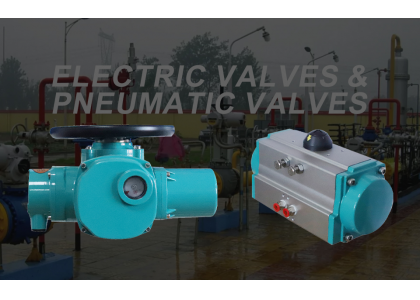
Electric Valves
The electric valve actuator is mainly used in power plants or nuclear power plants because it is required to have a smooth, stable and gradual process in high-pressure water systems. The main advantage of the electric actuator is its high stability and the constant thrust that can be applied by the user. The maximum thrust produced by the actuator can reach up to 225,000 kgf. Only hydraulic actuators can achieve such a large thrust, but hydraulic actuators are much more expensive than electric ones. The anti-deviation ability of the electric actuator is very good. The output thrust or torque is basically constant and can well overcome the unbalanced force of the medium to achieve accurate control of process parameters. Therefore, the control accuracy is higher than that of pneumatic actuators. If a servo amplifier is used, the positive and reverse actions can be easily interchanged, and the valve position state (keep/open/closed) can be easily set when the signal is interrupted. During a fault, it will definitely remain in the original position, which is something that pneumatic actuators cannot do. Pneumatic actuators must rely on a set of combined protection systems to achieve position retention.
The disadvantages of the electric actuator mainly include:
The structure is more complex, and it is more prone to failure. Due to its complexity, the technical requirements for on-site maintenance personnel are relatively higher.
The motor operation generates heat. If the adjustment is too frequent, it is easy to cause the motor to overheat and trigger thermal protection. At the same time, it will also increase the wear of the reduction gear. In addition, it runs slowly. From the output signal of the regulator to the valve responding and moving to the corresponding position, it takes a relatively long time. This is why it is inferior to pneumatic and hydraulic actuators.
Pneumatic Valves
The actuator of the pneumatic valve is a unified whole of the actuator and the regulating mechanism. The actuator of the pneumatic valve has two types: diaphragm type and piston type. The piston type has a long stroke and is suitable for occasions requiring a large thrust; while the diaphragm type has a smaller stroke and can only directly drive the valve stem. Due to the simplicity of the structure, large output thrust, stable and reliable operation, and safety and explosion-proof advantages of the pneumatic actuator, it is widely used in production processes with high safety requirements such as power plants, chemical plants, and oil refineries.
The main advantages of the pneumatic actuator are:
It accepts continuous air signals and outputs linear displacement (after the electrical/air conversion device, it can also accept continuous electrical signals), and with a rocker arm, it can output angular displacement.
It has positive and reverse action functions.
The moving speed is large, but it will slow down when the load increases.
The output force is related to the operating pressure.
It has high reliability, but the valve cannot be retained when the air source is interrupted (with a retention valve, it can be retained).
It is inconvenient to achieve segmented control and program control.
Maintenance and repair are simple, and the adaptability to the environment is good.
The output power is large.
It has explosion-proof function.
Goldensea is one of the Global leading water valve suppliers and ductile iron butterfly valve manufacturers, which was established in the year 1991. The main products are butterfly valves...[ read more ]


