
info@cngoldensea.com
+(86)15122654356
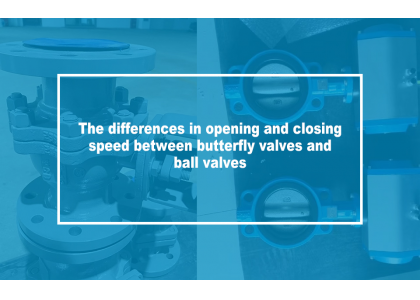
There are usually some differences in opening and closing speed between butterfly valves and ball valves. Generally speaking, the opening and closing speed of ball valves is usually faster than that of butterfly valves. Here is a detailed analysis:
Structural principle factors
Butterfly valve: The butterfly valve is opened and closed by rotating a disc-shaped butterfly plate. The butterfly plate rotates around the axis inside the valve body, and it needs to rotate 90 degrees from closed to open or from open to closed. In practical applications, due to the influence of factors such as fluid resistance and friction between the valve shaft and the sealing components during the rotation of the butterfly plate, its rotation speed is limited. Especially in large-diameter butterfly valves, these influences are more obvious.
Ball valve: The ball valve uses a circular opening on the ball to control the flow of fluid. The ball rotates 90 degrees around the axis of the valve stem to complete the opening and closing action. When the ball rotates, the contact between the ball and the valve seat is relatively smooth, and the flow channel design of the ball makes the resistance of the fluid to the ball in the opening moment relatively small, which is more conducive to rapid rotation.
Actuating mechanism factors
Butterfly valve: The torque required for the actuating mechanism of butterfly valves is usually relatively low. Because the resistance that the butterfly plate needs to overcome mainly consists of rotational friction and certain fluid resistance. In general, electric or pneumatic actuators used to drive butterfly valves will control the rotation speed to ensure the positioning accuracy and sealing performance of the butterfly plate. They will not allow the butterfly plate to rotate quickly to avoid generating large impact forces that affect the seal and the lifespan of the valve.
Ball valve: High-torque actuators can be equipped for ball valves. Due to the relatively simple resistance characteristics of the ball's rotation, the actuating mechanism can more efficiently transfer power to the ball to achieve rapid rotation. Especially in some scenarios that require rapid cutting or opening, such as emergency shut-off systems, ball valves can achieve very rapid opening and closing actions by being equipped with high-performance actuators. The opening and closing time can be completed within seconds or even shorter.
However, the opening and closing speed of butterfly valves and ball valves is not absolute. In some special designs or specific working conditions, the opening and closing speed of butterfly valves may be close to or even exceed that of ordinary ball valves. For example, some small-sized butterfly valves with special lightweight butterfly plates may have a relatively fast opening and closing speed driven by low-torque, high-speed actuators; while some large-diameter, high-pressure-grade ball valves, due to considerations of sealing and structural strength, their opening and closing speed may be reduced.
Goldensea is one of the Global leading water valve suppliers and ductile iron butterfly valve manufacturers, which was established in the year 1991. The main products are butterfly valves...[ read more ]


