
info@cngoldensea.com
+(86)15122654356
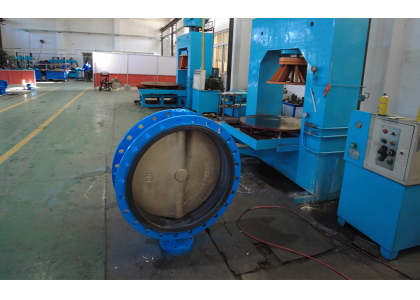
A butterfly valve refers to a type of valve where the closing element (valve disc or butterfly disc) is a circular disc that rotates around the valve axis to achieve opening and closing. It is mainly used for cutting off and throttling in pipelines. The closing element of a butterfly valve is a disc-shaped butterfly disc, which rotates within the valve body to achieve the purpose of opening or closing or regulation. The full opening and full closing of the butterfly valve is usually less than 90°. The butterfly valve and the butterfly handle themselves do not have self-locking capabilities. To position the butterfly disc, a worm gear reducer needs to be installed on the valve stem. Using a worm gear reducer can not only make the butterfly disc have self-locking capabilities, allowing it to stop at any position, but also improve the operating performance of the valve. The characteristics of industrial butterfly valves include the ability to withstand high temperatures, a higher applicable pressure range, a large nominal diameter of the valve, and the valve plate's sealing ring using metal rings instead of rubber rings. Large high-temperature butterfly valves are manufactured by steel plate welding and are mainly used in smoke and air ducts and gas pipelines with high-temperature media.
Butterfly valves can be classified by structural form into offset disc type, vertical disc type, inclined disc type, and lever type. They can be classified by sealing form into two types: relatively sealed type and metal sealing type. Relatively sealed type generally uses rubber ring sealing, while metal-sealing type usually uses metal ring sealing. They can be classified by connection type into flange connection and wafer type connection; by transmission mode into manual, gear transmission, pneumatic, hydraulic, and electric types.
Advantages of Butterfly Valves
1. Convenient and rapid opening and closing, low fluid resistance, and can be operated frequently.
2. Simple structure, small size, and light weight.
3. It can transport slurry, and the liquid accumulation at the valve opening is minimal.
4. Good sealing at low pressure.
5. Good regulating performance.
Installation and Maintenance of Butterfly Valves
1. The valve disc should be stopped at the closed position during installation.
2. The opening position should be determined according to the rotation angle of the butterfly disc.
3. For butterfly valves with a bypass valve, the bypass valve should be opened before opening the valve.
4. The butterfly disc of the butterfly valve is installed in the diameter direction of the pipeline. In the cylindrical channel of the butterfly valve body, the disc-shaped butterfly disc rotates around the axis, with a rotation angle of 0° to 90°. When the rotation angle reaches 90°, the valve is in the fully open state.
5. If the butterfly valve is used for flow control, the main thing is to correctly select the size and type of the valve. The structural principle of the butterfly valve is particularly suitable for manufacturing large-diameter valves. Butterfly valves are not only widely used in general industries such as petroleum, gas, chemical, and water treatment, but also applied in cooling water systems of thermal power plants.
6. Common butterfly valves include wafer-type butterfly valves and flange-type butterfly valves. Wafer-type butterfly valves are connected between two pipe flanges using double-headed bolts, while flange-type butterfly valves have flanges on the valve and are connected to the pipe flanges using bolts.
Goldensea is one of the Global leading water valve suppliers and ductile iron butterfly valve manufacturers, which was established in the year 1991. The main products are butterfly valves...[ read more ]


