
info@cngoldensea.com
+(86)15122654356
Control Mechanism
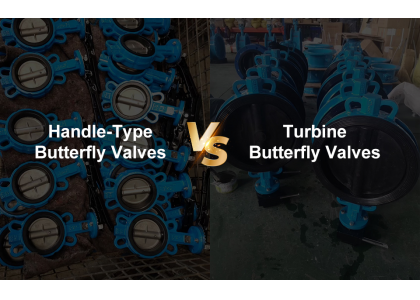
The turbine butterfly valve adopts a turbine transmission structure, with the core components being the turbine and the worm gear. When fluid passes through the valve, the turbine rotates under the action of the fluid, and through the worm gear transmission, it drives the valve plate to rotate, thereby achieving the regulation of the valve opening. This control method has the characteristic of high flow regulation accuracy, and is particularly suitable for occasions that require precise control of flow, such as chemical processes, water treatment, etc., where there are large flow pipelines.
In contrast, the handle-type butterfly valve adopts a mechanical manual operation method. Users directly control the position of the valve plate by rotating the handle to achieve the opening and closing of the valve. This control method is simple and intuitive, and does not require complex transmission mechanisms, so the structure is more compact and reliable, and is commonly used in low-pressure systems such as building water supply and drainage, HVAC, etc. Applicable scenarios
The turbine butterfly valve is particularly suitable for process pipelines that require continuous flow regulation due to its high-precision flow control capability. For example, in chemical production, the turbine butterfly valve can precisely control the flow of reactants to ensure the stability and safety of the reaction process. Additionally, in the water treatment field, the turbine butterfly valve is often used to regulate water flow to meet the requirements of different treatment stages.
The handle-type butterfly valve is more suitable for occasions that require frequent opening and closing. Due to its simple operation, users can quickly open or close the valve, and thus is widely used in low-pressure environments such as building water supply and drainage systems, and HVAC systems. For example, in the fire protection system of buildings, the handle-type butterfly valve can quickly cut off the water source to prevent the spread of fire.
Maintenance requirements
The turbine butterfly valve has relatively high maintenance requirements due to its turbine transmission structure. The turbine mechanism requires regular lubrication and maintenance to ensure the smooth operation of the transmission components. In addition, the sealing parts of the turbine butterfly valve also need to be inspected and replaced regularly to prevent leakage.
The maintenance of the handle-type butterfly valve is relatively simple. Due to its compact structure and few transmission components, it requires almost no special maintenance. Users only need to regularly check the sealing performance of the valve to ensure no leakage.
Selection suggestions
When selecting, users should choose the appropriate type of butterfly valve based on the specific application scenario and requirements. For high-temperature, high-pressure, or highly automated working conditions, the turbine butterfly valve has more advantages due to its high-precision flow regulation capability and stable performance. For ordinary pipeline systems with low operation frequency and limited budget, the handle-type butterfly valve is more attractive due to its economy and simplicity.
Goldensea is one of the Global leading water valve suppliers and ductile iron butterfly valve manufacturers, which was established in the year 1991. The main products are butterfly valves...[ read more ]


