
info@cngoldensea.com
+(86)15122654356
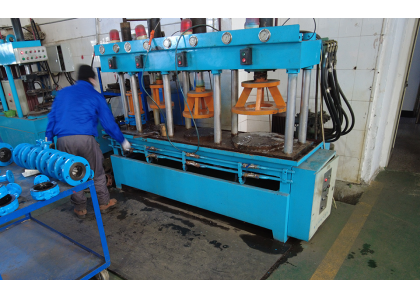
Before installing the valves, they should undergo dual tests for strength and sealing on a hydraulic testing bench. The available test media include water, oil, air, steam, and nitrogen.
Testing Method for Gate Valves
The strength test of gate valves is conducted by placing the valve on a testing frame and checking for leakage in the valve body and packing. For gate valves, the strength test typically involves placing the assembled valve on the testing frame, opening the valve disc, and injecting the medium to a preset pressure value. During this process, it is necessary to carefully check for any leakage or sweating on the valve body and valve cover. Additionally, the strength test of the gate valve can be conducted independently. During the sealing test, the valve stem of the gate valve should be in a vertical position, the valve disc should be open, and the medium should be injected through the introduction port to the specified pressure. Subsequently, check for any leakage at the packing and gasket. After the test is passed, close the valve disc and check for leakage from the other end. If the valve needs to undergo both strength and sealing tests, conduct the strength test first, depressurize to the specified pressure for the sealing test, and then check the packing and gasket again. Finally, place the valve in a half-open state, close both ends, fill the internal cavity with the medium, and further check the packing and gasket at the sealing surface to ensure there is no leakage.
Testing Method for Ball Valves
The strength test of pneumatic ball valves is conducted in a semi-open state. Different methods are used to check the sealing performance of floating, fixed, and three-way ball valves. For pneumatic ball valves, the strength test is conducted when the ball is in a semi-open state. This is because in this state, the internal structure of the ball valve can be fully displayed, which is more conducive to identifying potential problems. During the test, ensure that the sealing performance of the ball valve is good and pay close attention to any leakage or leakage phenomena.
For floating ball valves, we first place the valve in a semi-open state, then introduce the test medium to one end and keep the other end closed. Next, we rotate the ball several times to ensure that the valve is fully closed and then open the closed end for inspection. At the same time, also check the sealing performance at the packing and gasket to ensure there is no leakage. Then, we introduce the test medium from the other end and repeat the above test process.
For fixed ball valves, we need to allow the ball to rotate without load several times before the test. Then, place the fixed ball valve in a closed state and introduce the test medium to the predetermined pressure value from one end. Use a pressure gauge with an accuracy of 0.5-1 level and a range of 1.6 times the test pressure to check the sealing performance at the introduction end. If the pressure does not drop within the specified time, it is considered qualified. Next, introduce the test medium from the other end and repeat the above test steps. Finally, place the valve in a semi-open state with both ends closed, fill the internal cavity with the medium, and further check the packing and gasket at the sealing surface to ensure there is no leakage.
For three-way ball valves, we need to conduct sealing tests at all possible positions to ensure the comprehensiveness of their performance.
Testing Method for Butterfly Valves
The testing method for pneumatic butterfly valves is similar to that of gate valves, with particular attention to leakage at the butterfly plate and packing seal. During the sealing performance test, introduce the test medium from the medium inlet end, keep the butterfly plate open and the other end closed, and inject pressure to the preset value. After confirming that there is no leakage at the packing and other sealing areas, close the butterfly plate, open the other end, and further check if there is no leakage at the butterfly plate sealing area to determine if it is qualified. For butterfly valves used for flow regulation, the sealing performance test can be omitted.
Testing Method for Check Valves
In the test of check valves, the strength and sealing tests must be conducted in the specific direction of the valve disc to ensure no leakage. Ensure that the axis of the valve disc is at a specific position relative to the horizontal line. For lift check valves, the axis of the valve disc should be perpendicular to the horizontal plane; for swing check valves, the axis of the channel and the valve disc axis should be approximately parallel to the horizontal line. Next, during the strength test, we need to introduce the test medium from the inlet end and raise it to the predetermined test pressure. At the same time, we should seal the other end. Then, we should carefully observe whether there is any leakage in the valve body and valve cover to determine if it is qualified. In the sealing test, we need to introduce the test medium from the outlet end and carefully inspect the sealing surfaces, packing, and gaskets at the inlet end to ensure there is no leakage. Only then can it be regarded as qualified.
Goldensea is one of the Global leading water valve suppliers and ductile iron butterfly valve manufacturers, which was established in the year 1991. The main products are butterfly valves...[ read more ]


